

Today, we will review the 2024 BMW S 1000 RR Sports Motorcycle, but first, let’s take a brief look at the history of M motorcycles. At the conclusion of 2018, BMW Motorrad applied the successful M Motorsport automobile strategy to its motorcycle line, marking a significant step in expanding performance offerings across its range. Since then, BMW has introduced M-specific equipment and M Performance Parts for several motorcycle models. The 2023 BMW M 1000 R, also known as the M R, is the second M model from BMW Motorrad to make its global debut, following the renowned M 1000 RR superbike.
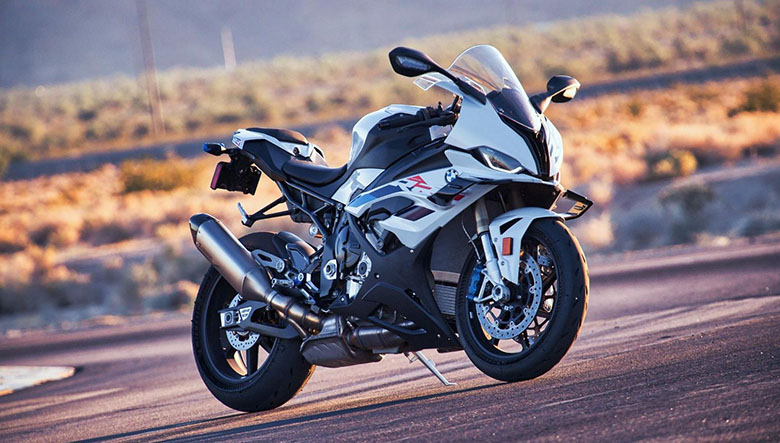
During the 50th anniversary celebration of BMW M GmbH, BMW Motorrad remained faithful to the brand’s legacy — the M symbol representing the most powerful letter in the world. This new M R model embodies that same spirit of motorsport excellence, combining track-ready performance with high-end road capability. The M emblem continues to signify racing dominance and exceptional performance on the road, catering to riders who demand superior power, exclusivity, and individuality.
Producing 205 horsepower with a weight of just 438.7 pounds, and featuring advanced suspension and aerodynamic engineering suited for both track and street, the new M R delivers an extraordinary riding experience previously exclusive to superbikes. Built on the foundation of the S 1000 R and 2024 BMW S 1000 RR Sports Motorcycle, the M 1000 R has been refined to match the unique demands of a high-performance supersport roadster.
2024 BMW S 1000 RR Sports Motorcycle – Features and Specs
Performance and Capability
Powering the 2024 BMW S 1000 RR Sports Motorcycle is a water-cooled, inline-four engine that is transversely mounted within the frame. The engine’s forward-leaning cylinder arrangement reduces spool-up time for quicker response. Acceleration is remarkable, achieving 0 to 62 miles per hour in just 3.1 seconds — a figure that ranks among the world’s best and ensures it can outpace nearly anything found on public roads.
Also Read: 2024 BMW R 1250 RS Sports Motorcycle Review
The 2024 version delivers an impressive 205 horsepower and 83 pound-feet of torque. The torque output remains strong across the rev range thanks to BMW’s ShiftCam technology, which adjusts the rotation of the intake camshaft. This system boosts low-end torque without compromising top-end power. The bore and stroke dimensions are 80 mm and 49.7 mm, respectively, giving a total engine displacement of 999 cc. The high compression ratio of 13.3:1 requires premium high-octane fuel to ensure smooth combustion and avoid misfires.
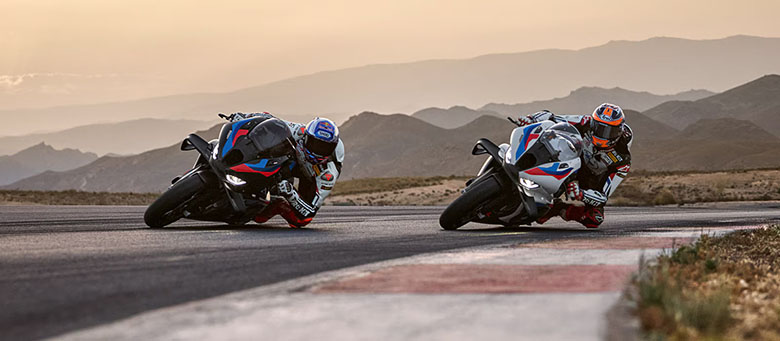
Additionally, variable intake pipes help reinforce low-end torque while maintaining performance at high RPMs. With a top speed of 188 miles per hour, the 2024 BMW S 1000 RR Sports Motorcycle is capable of keeping up with the fastest traffic on American highways with ease.
Design and Styling
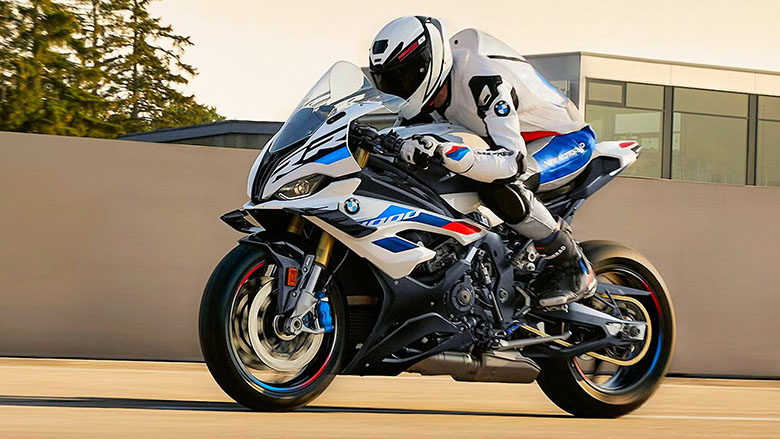
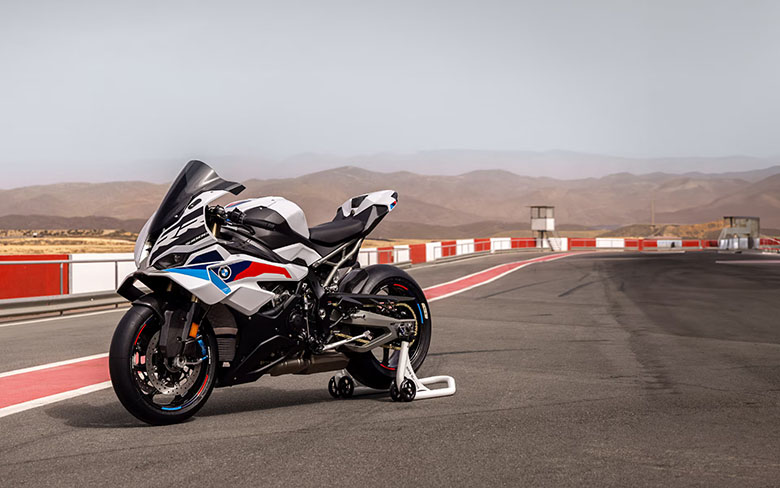
In the 2024 BMW S 1000 RR Sports Motorcycle, form is dictated entirely by function, with every part of the bodywork serving a distinct aerodynamic purpose while minimising unnecessary weight. The front section begins with a vented fender that channels air efficiently into the radiator grille, directing it smoothly around the front forks and along the streamlined fairing. The most striking feature is the pair of biplane winglets, which provide 37.7 pounds of downforce at 186 miles per hour, helping the front tyre maintain traction at extreme speeds.
The fairing features a compact design that includes street-legal lighting beneath a short bubble-style windscreen. This small screen cuts through the airflow efficiently, though the rider must tuck in closely to take full advantage. The low clip-on handlebars naturally draw the rider into an aerodynamic racing stance.
A robust fuel tank, combined with an elevated tail section, creates a deep seating area. The 32.4-inch seat height positions the rider securely within the bike for an ideal ergonomic fit. The tail fairing completes the streamlined look, carrying all the necessary road equipment. At the same time, the integrated mirror indicators at the front can be easily removed, and their mounts can be sealed when preparing for track sessions.
Chassis and Handling
The 2024 BMW S 1000 RR Sports Motorcycle’s bridge-type aluminium frame integrates the engine as a stressed component, reducing the need for excess frame material and thereby lowering the overall weight. This design contributes to exceptional agility and responsiveness. The lightweight aluminium swingarm complements this structure by further minimising both total and unsprung weight at the rear.
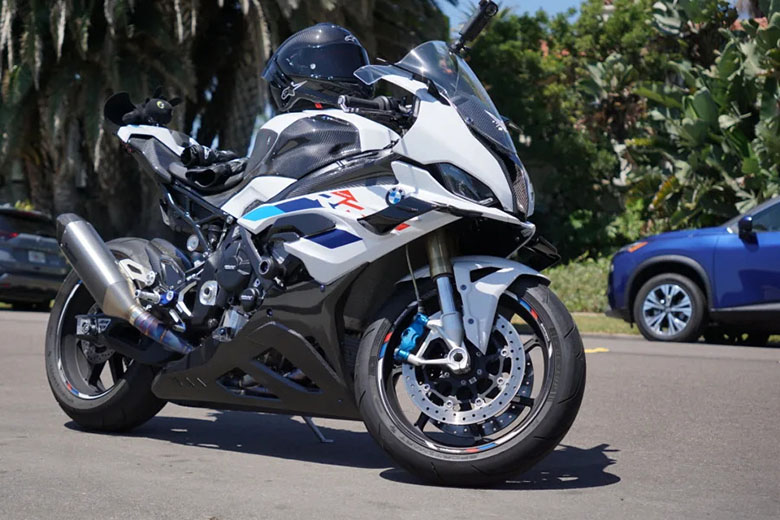
At the front, 45 mm USD forks manage suspension duties and offer full adjustability for preload, rebound, and compression. The rear features a central spring strut with identical adjustability options, allowing riders complete control over ride quality. Suspension travel is measured at 4.7 inches in the front and 4.6 inches at the rear. With a sharp 23.6-degree rake and 3.93 inches of trail, the S 1000 RR offers precise and quick handling, making it ideal for track performance, although it may be slightly intense for casual road use.
Seventeen-inch cast aluminium wheels are standard, paired with 120/70 in the front tire and 190/55 in rear tire on the base model, or an optional 200/55 setup with M wheels. The braking system features dual 320 mm front discs with radial-mounted four-piston callipers, and a single 220mm rear disc including a single-piston calliper. Advanced braking aids, such as BMW Motorrad Race ABS, Brake Slide Assist, and ABS Pro, come standard, supported by four selectable riding profiles that allow the rider to tailor the bike’s behaviour to various conditions instantly.
Also Read: 2024 BMW G 310 GS Adventure Motorcycle Review
Price and Availability
The manufacturer’s suggested retail price for the 2024 BMW S 1000 RR Sports Motorcycle begins at $23,985. At the time of this report, BMW has indicated availability with a general statement of “coming soon.”
2024 BMW S 1000 RR Sports Motorcycle Vs Honda CBR1000RR-R Fireblade SP
The Honda Fireblade SP, built with a rich racing heritage, stands as a formidable rival in the superbike category. It produces 186 horsepower in its U.S. configuration, drawing inspiration from Honda’s RC213V MotoGP machine. However, it lacks the extensive electronic systems that define the BMW, offering only torque control, selectable riding modes, and ABS compared to BMW’s comprehensive suite of rider aids.
Honda offers carbon-fibre accessories to reduce weight, and the Fireblade’s aerodynamic fairing features a spoiler design similar to BMW’s, effectively balancing the competition in this regard. Notably, Honda equips the Fireblade SP with electronically controlled Öhlins forks, which provide an advantage in suspension performance. With a retail price of $28,900, the Fireblade costs more, leaving the BMW S 1000 RR positioned as the more cost-effective option with a superior technology package.
2024 BMW S 1000 RR Sports Motorcycle Vs Ducati Panigale V4 R
The Ducati Panigale V4 R is designed for both road and track with a significantly powerful engine setup. Even in its street-legal configuration, it produces an impressive 207 horsepower, accompanied by a highly advanced electronics system that slightly surpasses BMW’s already comprehensive technology suite.
Much like the BMW, the Panigale V4 R incorporates wing-style aerodynamic elements on its front fairing to enhance downforce at higher speeds. However, these features only become effective above 100 miles per hour and reach their maximum impact near 180 miles per hour, making them less practical for everyday road riding. Ducati’s pricing reflects its exclusivity, with a starting price of $45,495 — nearly double that of the BMW — which places it beyond reach for many riders despite its elite performance.
2024 BMW S 1000 RR Sports Motorcycle – Technical Specifications
Engine
| Type | 4-cylinder, 4-stroke in-line engine (BMW ShiftCam) |
| Bore x stroke | 80 mm x 49.7 mm |
| Capacity | 999 ccm |
| Rated output | 210 hp at 13,750 rpm |
| Max. torque | 113 Nm at 11,000 rpm |
| Compression ratio | 13.3: 1 |
| Mixture control | Electronic injection, variable intake pipe |
| Emission control | Closed-loop 3-way catalytic converter |
Performance/fuel consumption
| Maximum speed | 303km/h |
| Fuel consumption per 100km based on WMTC | 6.4 l |
| CO2 emission based on WMTC | 149 g/km |
| Fuel type | Premium unleaded (max. 5 % ethanol, E5), 98 ROZ/RON, 93 AKI |
Electrical system
| Alternator | 450 W |
| Batterie | 12 V / 5 Ah, lithium-ion |
Power transmission
| Clutch | Multiplate clutch in oil bath, anti-hopping clutch, with self-reinforcement |
| Gearbox | Claw-shifted 6-speed gearbox with straight cut gears |
| Drive | Chain 525 17/46 |
| Traction control | DTC, slide control |
Chassis/brakes
| Rahmen | Bridge-type frame, cast aluminium, co-supporting engine |
| Front wheel location/suspension | Upside-down telescopic fork, diameter 45 mm, spring preload, rebound and compression stages adjustable |
| Rear wheel location/suspension | Aluminium swing arm, full floater pro, compression and rebound damping adjustable, adjustable spring preload |
| Suspension travel, front/rear | 120 mm / 117 mm |
| Wheelbase | 1,457 mm |
| Castor | 99.8 mm |
| Steering head angle | 66.2° |
| Wheels | Aluminium cast wheels |
| Rim, front | 3.50 x 17″ |
| Rim, rear | 6.00 x 17″ |
| Tyre, front | 120/70 ZR17 |
| Tyre, rear | 190/55 ZR17 (with M wheels: 200/55 ZR17) |
| Brake, front | Twin disc brake, diameter 320 mm, 4.5 mm, 4-piston fixed calliper (5 mm M wheels) |
| Break, rear | Single disc brake, diameter 220 mm, 1-piston floating calliper |
| ABS | BMW Motorrad Race ABS (partial integral), Brake-Slide-Assist |
| ABS Pro | BMW Motorrad ABS Pro (settings for RAIN, ROAD, DYNAMIC, RACE mode) |
Dimensions/weights
| Seat height at unladen weight | 824 mm |
| Inner leg curve at unladen weight | 1,845 mm |
| Usable tank volume | 16.5 l |
| Reserve | approx. 4 l |
| Length | 2,073 mm |
| Height | 1,205 mm |
| Width | 848 mm |
| Dry weight | 175 kg (M Package 173.3 kg) without battery |
| Unladen weight, road-ready, fully fuelled | 197 kg (M Package 193.5 kg) |
| Permitted total weight | 407 kg |
| Payload (with standard equipment) | 210 kg |