

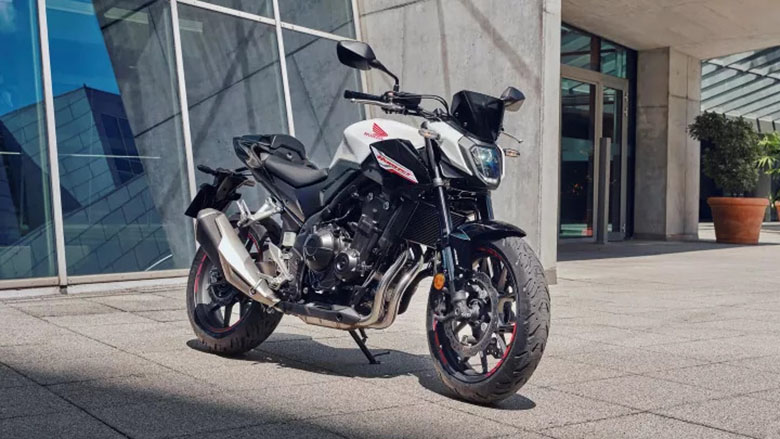
The new 2024 Honda CB500 Hornet Sports Motorcycle features a powerful engine and an extremely attractive chassis. The naked CB500F, first introduced in 2013 alongside the adventure-oriented CB500X (now known as the NX500) and the fully faired CBR500R, demonstrated the lasting relevance of one of Honda’s most successful motorcycle design formulas. That formula centres on combining an entertaining twin-cylinder engine with a lightweight, sporty chassis.
With its peak power output of 35 kW, the motorcycle has always been suitable for riders holding an A2 license. However, the CB500F has consistently offered more than what might typically be expected from an entry-level motorcycle. Its manageable character makes it easy to learn and ride, while still providing an engaging experience for riders moving up from smaller motorcycles or returning to a mid-capacity machine after owning larger bikes. Low running costs further strengthened its appeal.
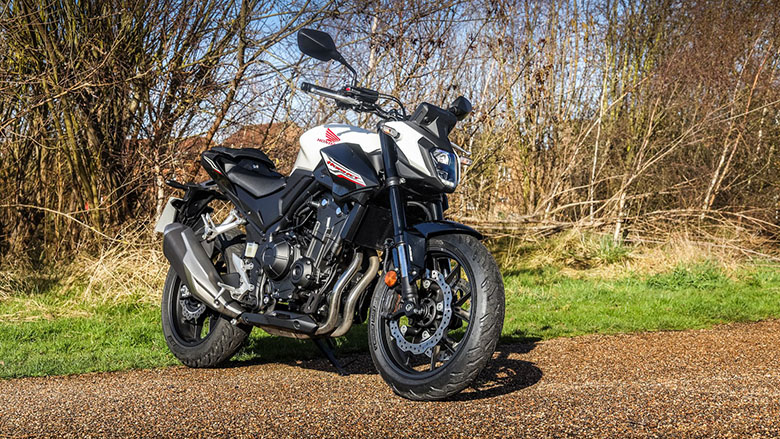
In 2019, the CB500F received a redesign featuring sharper lines that emphasised its technical and mechanical qualities. In 2022, further upgrades were introduced, including high-quality suspension in the form of Showa 41 mm Separate Function Fork Big Piston inverted forks, dual front brake discs, and newly designed lightweight wheels and swingarm.
For riders seeking a new experience, the 2024 Honda CB500 Hornet Sports Motorcycle builds on this foundation with a more aggressive, streetfighter-inspired design. Drawing inspiration from the larger Hornet models, the motorcycle combines a responsive A2-compatible twin-cylinder engine with a lightweight chassis designed for agile handling. The model also incorporates modern technology, including a five-inch full-colour TFT display, Honda RoadSync smartphone connectivity with turn-by-turn navigation, and Honda Selectable Torque Control to help manage rear-wheel traction.
2024 Honda CB500 Hornet Sports Motorcycle – Features and Specs
Styling & Equipment
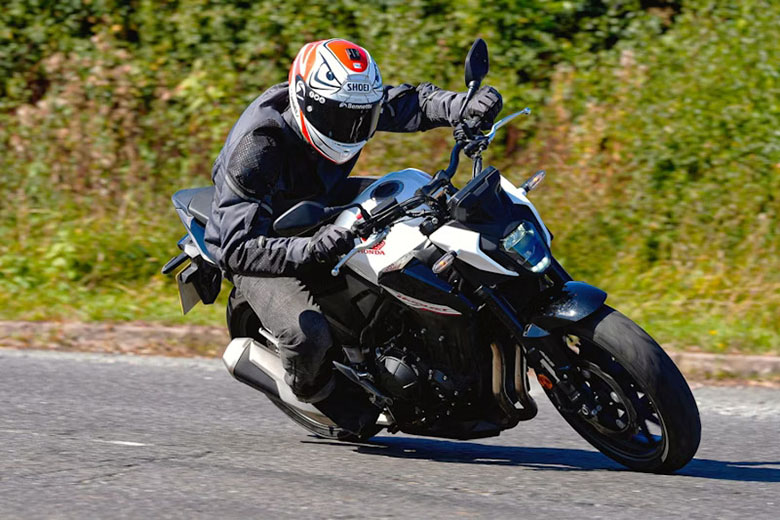
The 2024 Honda CB500 Hornet Sports Motorcycle adopts a bold new appearance inspired by the streetfighter styling of its larger sibling. The design concept, “Digital Dynamism,” focuses on creating a visually dynamic motorcycle with a strong sense of forward motion.
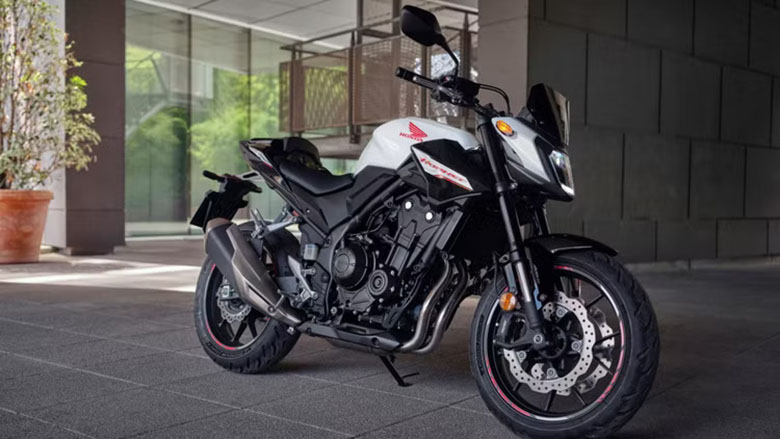
The overall shape flows from front to rear, forming a wedge-like silhouette that appears weighted toward the front. A slim rear section contrasts with the muscular fuel tank and sharply styled front fairing.
The design also serves a functional purpose. The angular surfaces of the front fairing incorporate ducts beside the headlight that channel airflow smoothly toward the upper section of the fuel tank. This aerodynamic design contributes to stable and responsive steering while improving the motorcycle’s overall handling agility.
A newly designed LED headlight provides wider light distribution while maintaining strong beam penetration, improving visibility during night riding and when cornering. The lighting system is completed with a sleek new LED taillight, and all motorcycle lights use LED technology.
Also Read: Top Ten Best Honda CB Bikes of All Time
The 2024 Honda CB500 Hornet Sports Motorcycle introduces a five-inch full-color TFT display inherited from the CB1000R. The screen uses optical bonding technology to improve readability in bright sunlight. By sealing the gap between the display glass and the TFT panel with resin, glare is reduced, and backlight transmission is improved.
The display can be configured with three layouts: Bar, Circle, and Simple. It also supports smartphone connectivity via Honda RoadSync, allowing riders to access navigation, calls, and music via a Bluetooth-enabled helmet headset.
The system is controlled using a backlit four-way toggle switch located on the left handlebar. Riders can download the Honda RoadSync application from the Play Store or App Store, connect their smartphone to the motorcycle and access the available features.
Tapered handlebars provide improved leverage and intuitive control. The seat height of 785 mm keeps the motorcycle easy to manage for riders of varying heights, while the neutral riding position offers comfort for both commuting and longer rides.
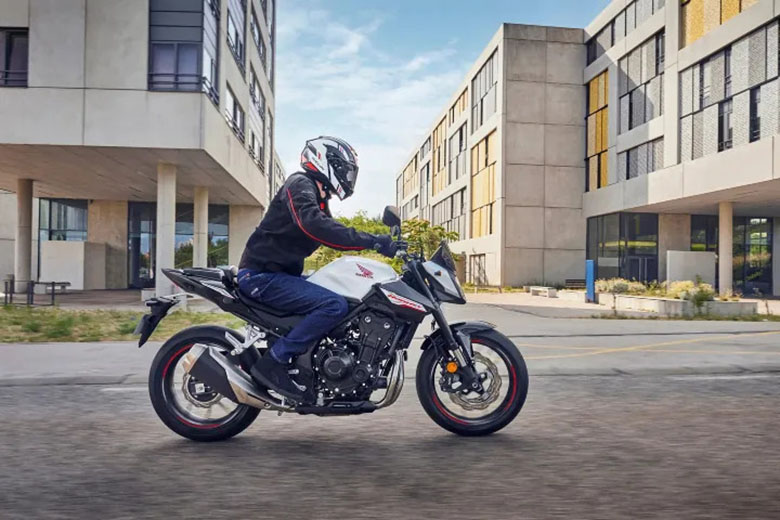
Lightweight aluminium footpegs enhance the motorcycle’s sporty appearance. The overall dimensions are 2080 mm in length, 800 mm in width, and 1060 mm in height, with a ground clearance of 145 mm.
The fuel tank holds 17.1 litres, including reserve. Combined with the engine’s fuel consumption of approximately 3.5 litres per 100 kilometres, the 2024 Honda CB500 Hornet Sports Motorcycle can achieve a riding range of more than 485 kilometres.
Chassis
The frame remains unchanged for 2024 and continues to use a 35 mm diameter steel diamond-tube structure that provides both strength and controlled flexibility. The frame’s design allows a small degree of yield, improving rider feedback when road surfaces change.
Engine mounting points and frame rigidity are carefully balanced to reduce vibration and maintain a stable riding feel.
The wheelbase measures 1410 mm, while rake and trail are set at 25.5 degrees and 102 mm, respectively. Weight distribution is evenly balanced at approximately 50 percent front and 50 per cent rear, contributing to predictable handling. The motorcycle has a kerb weight of 188 kilograms.
The 2024 Honda CB500 Hornet Sports Motorcycle is equipped with Showa 41 mm Separate Function Fork Big Piston inverted forks, similar to those used on the larger CB750 Hornet. These forks separate damping and spring functions between the two fork legs, improving suspension response and ride quality.
The swingarm is constructed from 2 mm steel and includes a hollow cross-member. This design provides rotational stiffness while allowing lateral flexibility that benefits cornering performance.
Also Read: Top Ten Best Motorcycles up to 500cc in 2025
The rear suspension uses a Showa single-tube shock absorber with a large-diameter piston, designed to maintain consistent performance even under demanding conditions. The rear shock features five preload adjustment levels.
Braking performance is provided by dual 296 mm front discs paired with Nissin radial-mount four-piston callipers. The rear brake uses a 240mm disc with a single-piston calliper.
Lightweight wheels feature five Y-shaped spokes. The front wheel measures 3.5 inches wide and is fitted with a 120/70-ZR17 tyre, while the rear wheel measures 4.5 inches wide and uses a 160/60-ZR17 tyre.
Engine
The 2024 Honda CB500 Hornet Sports Motorcycle features a 471 cc liquid-cooled parallel-twin engine with eight valves. Designed to deliver the maximum output permitted for A2 license regulations, the engine provides a balanced combination of compact size, responsive performance and enjoyable power delivery.
The engine produces a peak power of 35 kW at 8,600 rpm and a peak torque of 43 Nm at 6,500 rpm. Its lively character includes a strong, high-revving response while still delivering usable torque at lower engine speeds.
For 2024, the motorcycle gains Honda Selectable Torque Control, which helps manage rear-wheel traction and increases rider confidence. The system monitors front and rear wheel speeds to detect slip and automatically adjusts fuel injection to reduce torque smoothly when necessary. Riders can also deactivate the system if desired.
The engine uses Honda’s Programmed Fuel Injection system, which is supplied by a straight intake path through the airbox and throttle bodies. Optimised ignition timing and air-fuel ratios improve acceleration from low rpm while maintaining smooth and predictable throttle response.
The exhaust system uses a muffler with dual outlets that produce a distinctive sound characterised by a sharp tone at higher engine speeds.
The engine’s bore and stroke measure 67 mm by 66.8 mm, and the compression ratio is set at 10.7 to one. The crankshaft uses a 180-degree firing order and incorporates a primary balance shaft located behind the cylinders near the motorcycle’s centre of gravity. Scissor gears are used for both the primary and balancer drives, helping reduce mechanical noise.
The crankshaft counterweight is designed to balance engine forces while remaining lightweight, enabling the engine to rev freely with reduced inertia.
The engine functions as a stressed member within the chassis, connecting to the frame through four mounting points. Inside the cylinder head, roller rocker arms and shim-type valve adjustment reduce valve spring load and friction.
The camshaft is driven by a silent chain treated with vanadium to reduce friction and increase wear resistance. The intake valves measure 26.0 mm in diameter, while the exhaust valves measure 21.5 mm.
The piston design is optimised to reduce noise at higher engine speeds, while striations on the piston skirt increase surface area and create channels for improved lubrication.
The internal layout of the crankshaft, main shaft and countershaft is arranged compactly to reduce engine size. The crankcases use centrifugally cast thin-walled sleeves, and their internal design reduces pumping losses that can occur with a 180-degree firing configuration.
A deep oil sump improves lubrication during aggressive cornering and braking, and total oil capacity is 3.2 litres.
Power is transmitted through a smooth-shifting six-speed gearbox equipped with an assist-and-slipper clutch. This system reduces rear-wheel hop during aggressive braking and downshifting while also making clutch operation easier.
2024 Honda CB500 Hornet Sports Motorcycle – Technical Specifications
Engine
| Type | Liquid-cooled 4 stroke, DOHC parallel twin |
| Displacement | 471cc |
| No of Valves per Cylinder | 4 |
| Bore & Stroke | 67mm x 66.8mm |
| Compression Ratio | 10.7: 1 |
| Max. Power Output | 35kW @ 8600rpm |
| Max. Torque | 43Nm @ 6500rpm |
| Noise Level (dB) | Lurban 73.5dB Lwot 76.8dB |
| Oil Capacity | 3.2L |
Fuel System
| Carburation | PGM FI electronic fuel injection |
| Fuel Tank Capacity | 17.1L (inc reserve) |
| CO2 Emissions (WMTC) | 80 g/km |
| Fuel Consumption | (WMTC) 3.5L/100km (28.6km/litre) |
Electrical System
| Battery Capacity | 12V 7.4AH |
| ACG Output | 23.4A/2000rpm |
Drivetrain
| Clutch Type | Wet multiplate, Assisted slipper clutch |
| Transmission Type | 6 speed |
| Final Drive | Chain |
Frame
| Type | Steel diamond |
Chassis
| Dimensions (L´W´H) | 2,080mm x 800mm x 1,060mm |
| Wheelbase | 1,410mm |
| Caster Angle | 25.5° |
| Trail | 102mm |
| Seat Height | 785mm |
| Ground Clearance | 145mm |
| Kerb Weight | 188kg |
| Turning radius | 2.7m |
Suspension
| Type Front | Showa 41mm SFF-BP USD forks, |
| Type Rear | Prolink mono with 5 stage pre-load adjuster, Steel hollow cross swingarm |
Wheels
| Type Front | 5Y-Spoke Cast Aluminium |
| Type Rear | 5Y-Spoke Cast Aluminium |
| Rim Size Front | 17 x MT3.5 |
| Rim Size Rear | 17 x MT4.5 |
| Tyres Front | 120/70ZR17M/C (58W) |
| Tyres Rear | 160/60ZR17M/C (69W) |
Brakes
| ABS System Type | 2-channel |
| Type Front | Dual 296mm x 4mm disc with Nissin radial-mount four piston calipers |
| Type Rear | Single 240mm x 5mm disc with single piston caliper |
Instruments & Electrics
| Instruments | 5in TFT Meter with customisable layout, including but not limited to Speedometer, Tachometer, Clock, Gear position, Shift UP Indicator |
| Headlight | LED |
| Taillight | LED |
| Connectivity | Yes (Honda RoadSync) |
| USB | No |
| 12V Socket | Optional |
| Auto Winker Cancel | No |
| Quickshifter | No |
| Security System | HISS (Honda Intelligent Security System) |
| Cruise Control | No |
| Additional Features | ESS |