

The new 2024 Honda Gold Wing Tour Bike has defined long-distance motorcycle touring for more than five decades. The 2024 model continues this legacy with the Gold Wing Tour, Gold Wing Tour Automatic DCT and Gold Wing Tour Airbag Automatic DCT. Each version is powered by Honda’s well-known 1833cc six-cylinder engine and incorporates a wide range of advanced technology and touring-focused features.
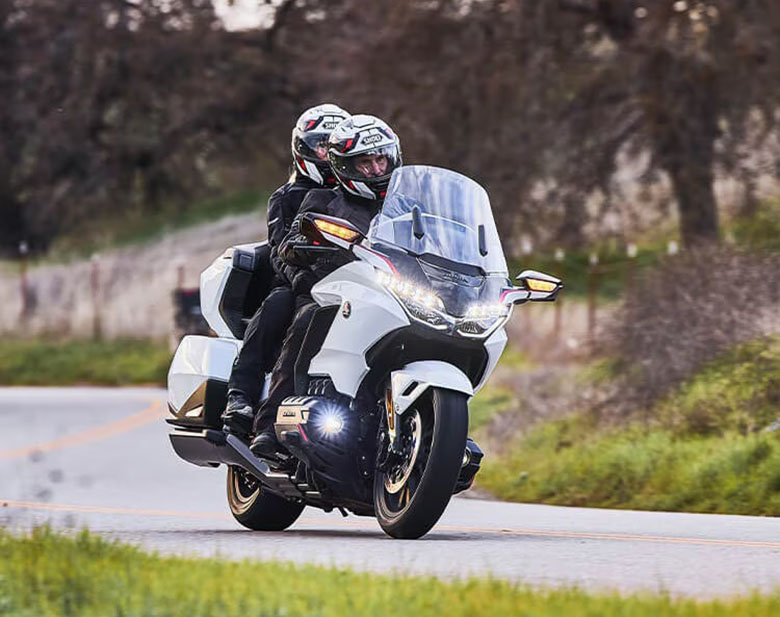
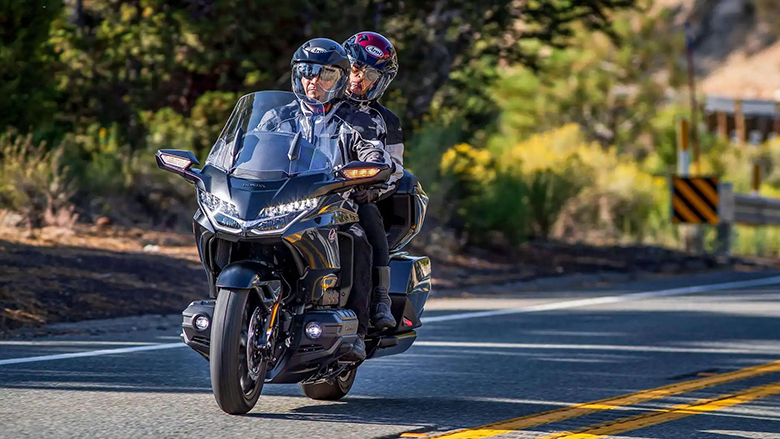
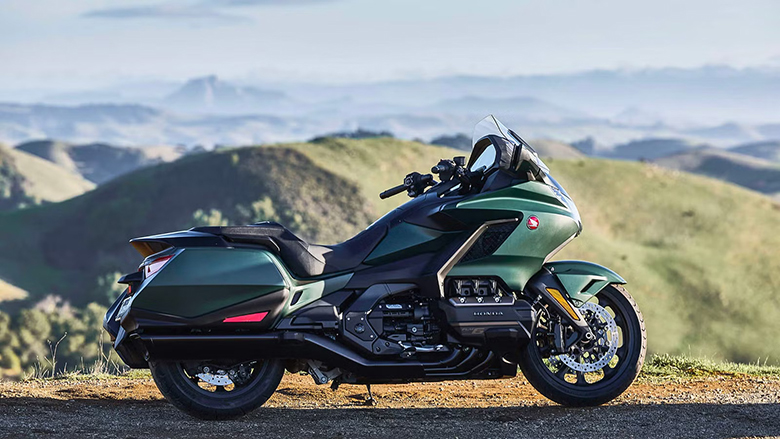
These motorcycles offer generous storage capacity, advanced connectivity features, i.e. Apple CarPlay and Android Auto, and a choice of two transmission systems. Riders can select a conventional six-speed manual gearbox or Honda’s advanced seven-speed Dual-Clutch Transmission. For 2024, the 2024 Honda Gold Wing Touring Motorcycle and Tour DCT versions are available in a Grey Metallic and Black colour combination, while all three variants can also be ordered in Pearl White. The result is a touring motorcycle designed to deliver long-distance comfort, performance and modern connectivity.
2024 Honda Gold Wing Tour Bike – Features and Specs
Innovative Technology, Endless Adventure
The 2024 Honda Gold Wing Tour Bike is equipped with a Six speed manual transmission, while the Dual-Clutch Transmission version features seven gears. The DCT system is calibrated so that clutch feel, shift speed and engine rpm during gear changes are tailored specifically to each riding mode. In addition, the DCT system includes a creep function that allows the motorcycle to move slowly forward or backwards when manoeuvring in tight spaces. The manual version uses the same electric reverse system found on earlier Gold Wing models.
The manual transmission incorporates a cam damper positioned between the clutch and gearbox. This design separates the inertial masses of the drivetrain components, helping reduce noise and improving both shift durability and overall shift quality. The clutch system also uses a cam-assist and slipper-clutch arrangement, replacing the traditional hydraulic-assist design. This mechanism uses fewer clutch discs and reduces hydraulic friction in the release system, lowering clutch lever effort by approximately 20% while improving the smoothness of downshifts. The slipper mechanism further enhances the refined feel of the gearbox.
Also Read: Top Ten Best Naked Bikes in 2025
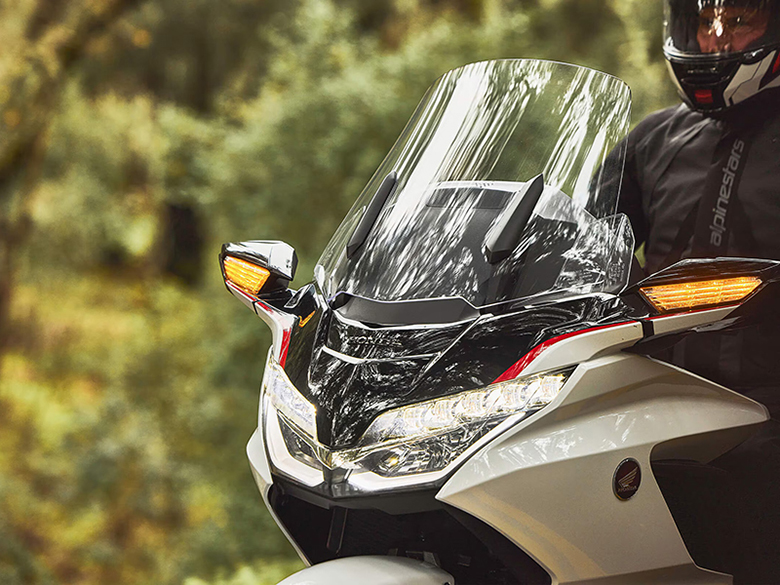
The 2024 Honda Gold Wing Tour Bike delivers a sense of freedom and long-distance riding enjoyment while combining performance with elegant styling. Its aerodynamically shaped fairing channels airflow around the rider, and the electrically adjustable windscreen allows customisation of wind protection. The seats are designed for all-day comfort and feature an ideal combination of suede and synthetic leather. Passenger comfort is also improved through a more relaxed angle for the pillion backrest.
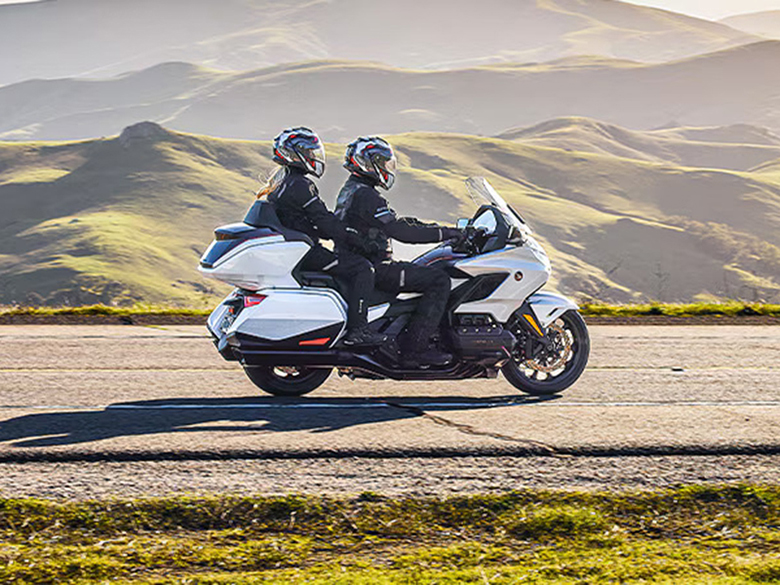
The motorcycle is equipped with high-quality speakers designed to deliver clear audio. Additional convenience features include Smart Key operation, Bluetooth connectivity and smartphone integration through Apple CarPlay and Android Auto.
Chassis
The 2024 Honda Gold Wing Tour Bike uses a die-cast aluminium twin-beam frame engineered to position the engine compactly within the chassis. The frame’s structural thickness varies throughout its construction to deliver a stable, smooth ride under a wide range of conditions, from slow-speed urban riding to high-speed highway touring.
One of the key chassis features is the double-wishbone front suspension. This design moves the front wheel forward under full-suspension compression, reducing the sliding friction typically generated by conventional telescopic forks. In this system, bearings are used at all shaft bushings for both steering and suspension movement, further reducing friction and improving ride quality.
Steering input is separated from suspension movement using dual fork holders and a single front shock absorber. This layout contributes to the motorcycle’s agility and makes it easier to steer despite its size. Patented steering cross tie-rod links connect the handlebars to both the front axle and the handlebar pivot, delivering a natural steering feel.
The 2024 Honda Gold Wing Tour Bike has a rake angle of 30.5 degrees, a trail of 109 mm, and a wheelbase of 1695 mm. The wet weight of the manual transmission model is 385 kilograms, while the DCT version weighs 390 kilograms.
Braking performance is provided by Honda’s Dual Combined Brake System, which distributes braking force between the front and rear wheels for improved stability. A single lightweight ABS modulator integrated with the brake control unit helps reduce overall system weight. Braking behaviour is also automatically adjusted according to the selected riding mode. The front wheel uses dual 320 mm discs with six-piston callipers, while the rear wheel features a 316 mm disc with a three-piston calliper.
The 2024 Honda Gold Wing Tour Bike also uses a Pro-Arm swingarm mounted to the left side of the frame. The right side remains open for easier maintenance access. This design provides greater packaging flexibility and improves stability. The Pro-Link suspension system delivers progressive suspension action and comfort, while spherical joints eliminate torsional forces.
Also Read: Top Ten Best 125cc Scooters in 2025
Suspension damping is electronically adjustable and linked to the riding mode selection. Stepper motors located in the front and rear shock absorbers control oil flow by adjusting internal needles, allowing damping force to adapt to the riding conditions. Rear spring preload is also electronically adjustable. Four preload settings correspond to different load conditions: solo riding, riding with luggage, riding with a passenger, and riding with both a passenger and luggage. These settings can be viewed on the TFT display and adjusted through handlebar controls.
Engine
To complement the advanced chassis and maintain the distinctive performance characteristics associated with the Gold Wing, Honda redesigned the 1833cc engine when the latest generation debuted in 2018. The engine remains a horizontally opposed flat-six configuration, but it now uses four valves per cylinder instead of two. The design is also more compact and approximately 6.2 kilograms lighter than the previous version.
The engine produces a peak power of 93 kW at 5,500rpm and a peak torque of 170 Nm at 4,500 rpm. Both bore and stroke measure 73 mm, and the left and right cylinders are offset by four millimetres. Aluminium cylinder sleeves are used, with a compression ratio of 10.5:1.
The Unicam cylinder head design operates intake valves through finger-follower rocker arms and exhaust valves through roller rocker arms. Both sets of valves share a coaxial rocker-arm shaft.
The combustion chambers use a four-valve pentroof configuration. The intake ports are designed to promote tumble airflow within the cylinders, improving combustion efficiency. The piston skirts are coated with molybdenum to reduce friction.
Throttle By Wire engine management allows the rider to select four riding modes that influence throttle response, suspension damping and braking behaviour through the Dual Combined Brake System.
TOUR mode provides the standard balance of power delivery and comfort. It offers a direct one-hundred per cent relationship between throttle input and throttle body opening while maintaining default suspension damping and brake distribution.
SPORT mode increases throttle responsiveness and delivers stronger acceleration while also using firmer suspension damping and increased rear brake pressure.
ECON mode focuses on fuel efficiency and relaxed cruising by reducing throttle sensitivity while maintaining standard damping and braking characteristics.
RAIN mode adjusts the motorcycle for wet or slippery conditions by using the lowest throttle response, standard braking force distribution and softer suspension damping.
Honda Selectable Torque Control continuously monitors rear-wheel traction and adjusts power delivery when necessary to maintain stability. The level of traction control intervention also varies according to the selected riding mode.
Two air intake ducts are positioned at the front left and right rear of the engine. These ducts create swirling airflow as air enters the system, allowing the air filter’s entire surface area to be used efficiently while reducing intake resistance. The shape of the intake ducts is also optimised for the engine’s low-rpm intake pulses, improving response and torque at small throttle openings. A single throttle body further improves airflow speed and engine response.
The exhaust system is designed to produce a deep and powerful tone without excessive noise. The cross-sectional area of the exhaust pipes for two of the six cylinders has been reduced by 20%, enhancing both the volume and depth of the sound.
The Integrated Starter Generator combines the functions of the starter motor and the new generator into a single component. When supplied with reverse electrical power, the generator operates as the starter motor. This system is approximately 2.4 kilograms lighter than conventional systems and uses helical gears to reduce mechanical noise.
The DCT version also includes an Idling Stop feature. When the motorcycle comes to a stop with the system activated, the engine automatically shuts off after three seconds. When the rider opens the throttle again, the engine restarts immediately. The system applies hydraulic pressure to the DCT clutch circuit in advance to reduce delay when moving off. Throttle-by-wire control ensures the throttle butterfly opens gradually during restarts, maintaining smooth acceleration. The Idling Stop function can be turned on or off using the handlebar controls.
Hill Start Assist is provided on both the manual and DCT models. When the motorcycle stops on an incline, squeezing the brake lever activates the ABS modulator, which generates hydraulic pressure for the rear brake. When the rider unleashes the brake lever, the system temporarily maintains braking pressure for approximately three seconds. This allows the rider to apply throttle and move away smoothly on an uphill slope. When the system is active, a Hill Start Assist indicator appears on the instrument display.
The six-speed manual transmission also includes a cam damper between the clutch and gearbox, which improves shift quality and reduces drivetrain noise. The cam assist and slipper clutch reduce clutch lever effort by approximately 20% and ensure smoother downshifts. The electric reverse system continues to provide additional convenience when manoeuvring the motorcycle.
2024 Honda Gold Wing Tour Bike – Price
The new 2024 Honda Gold Wing Tour Bike is priced at $28,700.
2024 Honda Gold Wing Tour Bike – Technical Specifications
Engine
| Type | 1,833cc horizontally opposed, liquid-cooled, six-cylinder four-stroke |
| Valve Train | Single overhead Unicam® including 4 valves per cylinder, finger-follower rocker arm on intake, roller-rocker arm on exhaust valves |
| Bore x Stroke | 73.0mm x 73.0mm |
| Compression Ratio | 10.5:1 |
| Induction | Fuel injection; single throttle body with 50mm bore, Throttle By Wire (TBW) |
| Ignition | Full transistorized ignition |
| Starter | Electric w/ Integrated Starter Generator System (ISG) |
| Transmission | 6-speed manual w/ Reverse |
| Clutch | Multi-plate wet |
| Final Drive | Shaft |
Suspension
| Front | Double-wishbone system w/ Showa shock absorber, 4.3 inches travel |
| Rear | Pro-Link® system w/ Showa shock absorber, 4.1 inches travel |
Brakes
| Front | (2) radially mounted 6-piston Nissin hydraulic calipers w/ 320mm rotors, electronically controlled combined ABS |
| Rear | (1) 3-piston Nissin hydraulic caliper with 316mm rotor, electronically controlled combined ABS |
Tires
| Front | 130/70-18 |
| Rear | 200/55-16 |
Measurements
| Rake (Caster Angle) | 30º |
| Trail | 109mm |
| Length | 102.9 in. |
| Width | 36.3 in. |
| Height | 56.4 in. (windscreen in low position) |
| Seat Height | 29.3 in. |
| Ground Clearance | 5.1 in. |
| Wheelbase | 66.9 in. |
| Fuel Capacity | 5.5 gal. |
| Curb Weight | 845 lbs. |
Other
| Colors | Gray Metallic/Black; Pearl White |